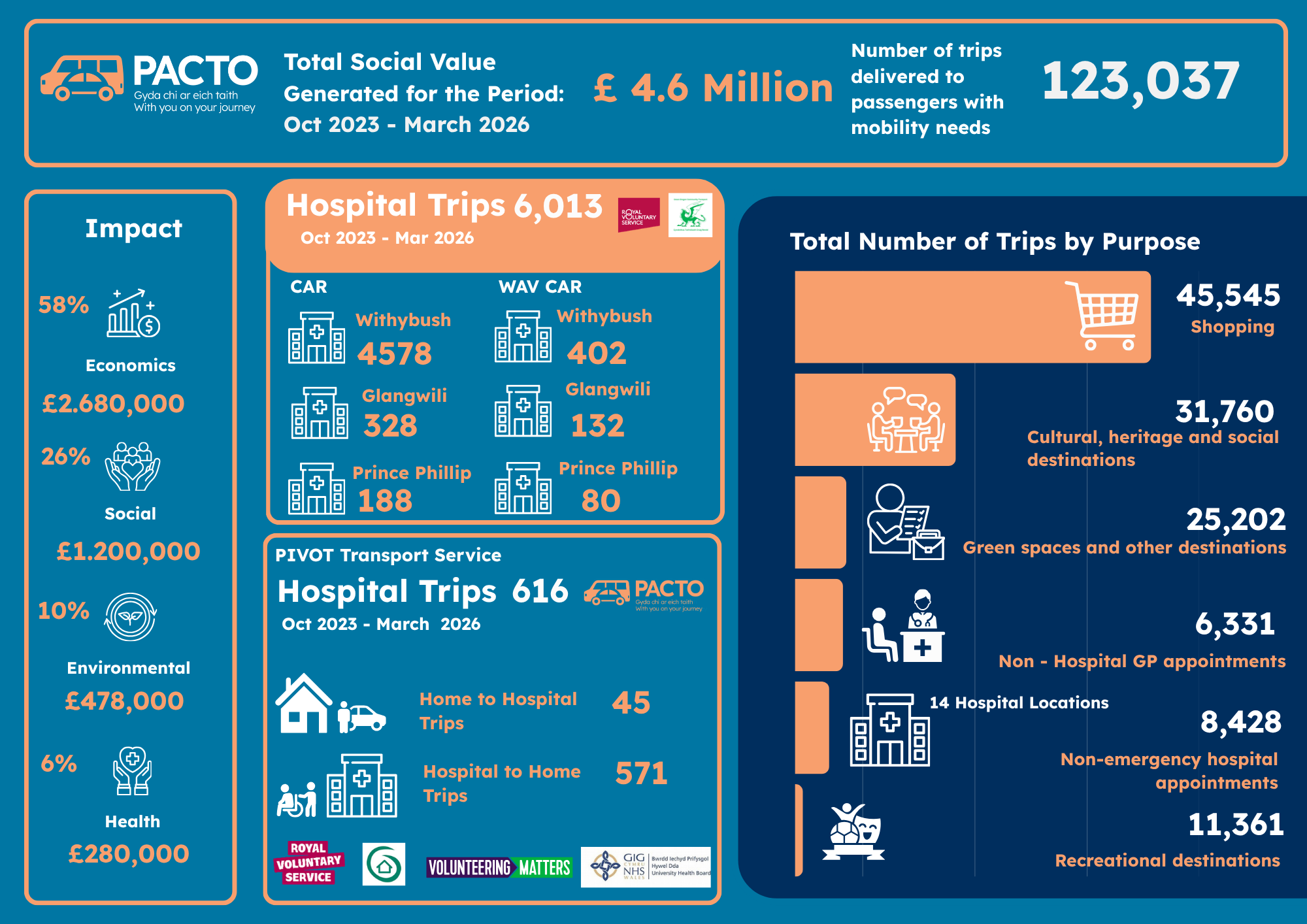
Social Value Impact Card
Social value refers to the wider economic, social, environmental and health benefits created by Community Transport. It
reflects the contribution that transport makes beyond simply moving people from one place to another, enabling access to essential services, supporting independence, reducing isolation and improving quality of life for individuals and communities.
To measure this impact, PACTO utilised the Ealing Community Transport (ECT) Social Value Tool, an outcome-based methodology designed to quantify the wider benefits generated through Community Transport services. The tool aligns with
recognised social value frameworks and captures outcomes such as improved wellbeing, increased independence, access to healthcare, social participation, volunteering, and reduced pressure on public services.
Between October 2023 and March 2026, Community Transport services across Pembrokeshire delivered 123,037 passenger journeys for people with mobility needs, generating an estimated £4.6 million in social value. Once data up until the end of September has been analysed, this figure is projected to reach a total of £6 million, as well as 160,000 passenger trips.
The social value generated is distributed across four key impact areas:
- Economic Value: £2.68 million (58%)
- Social Value: £1.20 million (26%)
- Environmental Value: £478,000 (10%)
- Health Value: £280,000 (6%)
Analysis of journey purposes further demonstrates the breadth of impact generated. Over the period, Community Transport enabled:
- 45,545 shopping trips
- 31,760 cultural, heritage and social journeys
- 25,202 trips to green spaces and other
destinations - 11,361 recreational journeys
- 8,428 non-emergency hospital appointments
- 6,331 GP and other healthcare appointments
It is important to recognise that the £4.6 million figure is likely to represent a conservative estimate of the true social value generated. The ECT Social Value Tool was originally developed using predominantly urban transport assumptions and does not fully account for the additional value created in rural areas such as Pembrokeshire, where transport alternatives are often limited or unavailable.